Good Morning, Italia!
In order to find the birthplace of modern political thinking, you’d need to go to the wealthy city-states of Florence, Venice, and Milan during the 1300s and 1400s. While the rest of Europe was still doing the feudalism thing with kings and lords and serfs, these Italian cities were running themselves more like competitive businesses. They had elected councils, merchant princes, and banking families who wielded huge power without any royal bloodline to back them up.
The peninsula was broken up into dozens of small, independent states that were constantly competing with each other for trade routes, territory, and prestige. The Pope controlled a chunk of central Italy, but the northern cities operated largely on their own. And because these cities got rich through trade and banking rather than farming, the people who ran them tended to be practical, ambitious, and not particularly interested in following rules just because tradition said so.
This environment created something historians call Renaissance humanism. Instead of looking to the Bible or the Church for all the answers, they go back and studied what the ancient Greeks and Romans had to say. Scholars started digging up old texts by Cicero, Aristotle, and Livy, and they were blown away because these ancient civilizations had built republics, debated philosophy, and governed themselves without needing a pope to tell them what to do.
The humanists didn’t necessarily reject Christianity (most of them were still devout Catholics), but they believed that human reason and classical learning could improve society. They developed the idea of civic republicanism — the belief that citizens had a duty to participate in public life and that a well-governed republic was the best form of government. This was a huge deal because it meant politics wasn’t just something kings and bishops did anymore. It was everybody’s business.
Machiavelli and The Prince
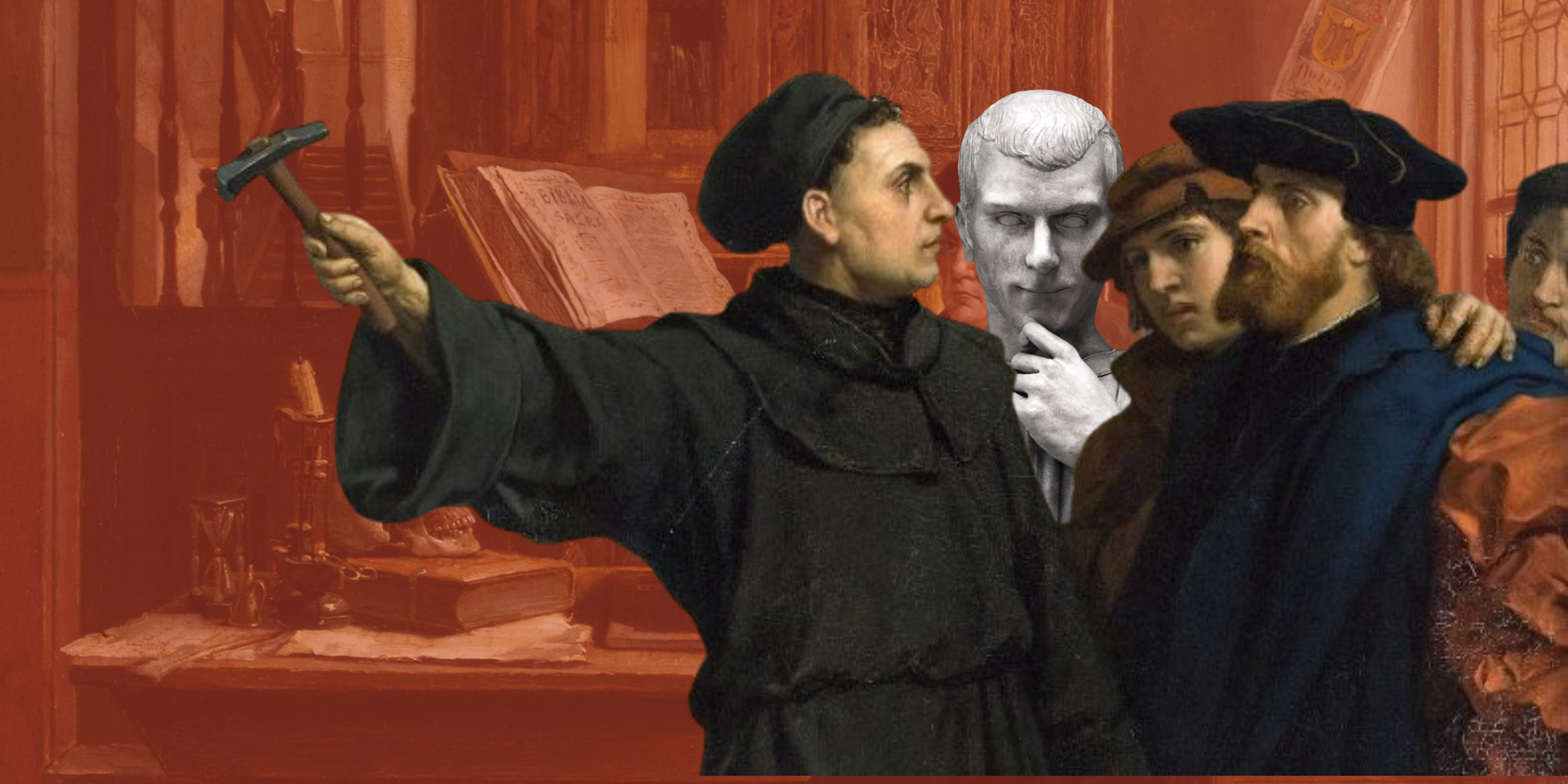
No conversation about Renaissance politics is complete without Niccolò Machiavelli, who might be the most misunderstood political thinker in history. Born in Florence in 1469, Machiavelli served as a diplomat and government official during one of the most chaotic periods in Italian history. He watched Florence get invaded, saw popes scheme like crime bosses, and witnessed rulers rise and fall based on nothing more than luck and ruthlessness.
In 1513, after being kicked out of government and getting tortured, Machiavelli sat down and wrote The Prince. The core argument of The Prince is that a ruler needs to be practical above all else. Machiavelli didn’t care whether a prince was kind; he cared about if the prince could hold onto power and keep his state stable. He famously wrote that it’s better to be feared than loved, and that a smart ruler should know when to break promises, use deception, and even be cruel if the situation calls for it.
Now, before you think Machiavelli was just some evil mastermind, there’s important context here. He wasn’t celebrating cruelty, he was describing how power actually functioned in his world. He’d seen firsthand what happened to rulers who were too nice or too trusting: they got overthrown, exiled, or killed. His other major work, the Discourses on Livy, actually makes a strong case for republican government and citizen participation.
What made Machiavelli truly revolutionary was that he separated politics from morality, or at least from religious morality. Before him, almost every political thinker in Europe started from the assumption that good government meant godly government. Machiavelli said: forget about what should be and focus on what is. This approach of studying politics based on how people actually behave rather than how they ought to behave is why he’s often called the father of modern political science.
We Didnt Start the Fire—But Martin Luther Did
While Italian thinkers were reimagining politics from a secular angle, a very different kind of revolution was brewing in Germany. In 1517, a monk named Martin Luther nailed his famous 95 Theses to a church door in Wittenberg, basically arguing that the Catholic Church had become corrupt and was ripping people off with practices like selling “indulgences” (pay money, get your sins forgiven — seriously). Luther’s original complaint wasnt a political statement, it was purely religious. He wanted to reform the Church, not destroy it.
The Catholic Church was the single most powerful political organization in Europe. The Pope controlled territory, collected taxes from every Catholic country, appointed bishops who often had as much power as local lords, and could excommunicate kings (which basically meant telling everyone in the kingdom that their ruler was damned and they didn’t have to obey him anymore). Challenging the Church meant challenging the whole political order.
Luther’s ideas spread like wildfire thanks to the printing press (basically the social media of the 1500s). Within a few years, German princes realized they could use Protestantism as a way to break free from the Pope’s authority and grab Church property while they were at it. This wasn’t purely cynical; many of these rulers genuinely believed Luther was right. But the political benefits of going Protestant were hard to ignore: you got to keep Church taxes, appoint your own religious leaders, and tell Rome to mind its own business.
The result was decades of religious wars that tore Europe apart. Catholic rulers fought Protestant ones. Entire regions switched back and forth between faiths depending on who won the latest battle. And the old medieval idea that all of Christian Europe was one big community under the Pope? That was dead.
Divorced, Beheaded, Rebranded: Henry VIII and His Breakup With the Pope
If you want a perfect example of how personal drama could reshape an entire country’s politics, look no further than Henry VIII of England. Henry’s story is famous: he wanted to divorce his first wife, Catherine of Aragon, because she hadn’t given him a male heir. The Pope said no. So Henry basically said, “Fine, I’ll start my own church,” and created the Church of England with himself as the head.
But Henry’s break with Rome which was formalized by the Act of Supremacy in 1534 was about way more than just his love life. It established a principle that would reshape English politics for centuries: the monarch, not the Pope, was the supreme authority in England over both church and state. It meant that political sovereignty, or the idea that there’s one final authority in a country and nobody from outside can override it had triumphed over the old medieval system where the Pope could boss around kings.
The consequences rippled outward for generations. Henry’s daughter Elizabeth I would use the Church of England to build a distinctly English national identity. The tension between Catholic and Protestant factions would drive English politics for the next 150 years, eventually contributing to a civil war and the execution of a king. And the basic question Henry raised about who got the final say in a country’s affairs? Became one of the defining political questions of the modern world.
Jean Bodin and the Invention of Sovereignty
With the Reformation breaking up the religious unity of Europe and civil wars breaking out everywhere, political thinkers needed a new framework. The old answers, like “because God says so” or “because that’s how we’ve always done it” weren’t cutting it anymore when half the country worshipped differently from the other half.
And thats where Jean Bodin comes in, a French lawyer and philosopher who published Six Books of the Commonwealth in 1576, right in the middle of France’s brutal Wars of Religion between Catholics and Protestants. Bodin’s big idea was sovereignty, or the concept that every state needs one supreme authority that has the final word on laws, and that this authority can’t be divided or shared.
In the 1500s it was radical. Medieval politics had been a messy web of overlapping authorities of kings, lords, bishops, the Pope, city councils, and guilds all claiming different kinds of power over the same people. Bodin said: no, there has to be ONE source of law that sits above everything else. He thought this sovereign power should belong to a monarch, but the concept itself could be applied to any form of government. (Spoiler: a couple centuries later, revolutionaries would argue that sovereignty belonged to the people.)
Bodin also developed the idea of religious tolerance as a political strategy. Having watched France tear itself apart over religion, he argued that a wise sovereign should allow different faiths to coexist rather than trying to force everyone into the same church. This wasn’t because Bodin was some kind of progressive hero, he was being practical. Religious wars were destroying France, and tolerance was the only way to hold the state together.
The Peace of Westphalia and How it Led to The Modern World
The rise of nation-states, the concept of sovereignty, the collapse of the Church’s political authority came together in 1648 with the Peace of Westphalia, which ended the Thirty Years’ War. If you’ve never heard of the Thirty Years’ War, here’s the short version: it was an absolutely devastating conflict that killed roughly eight million people and turned large parts of central Europe into wasteland. It started as a religious war between Catholics and Protestants in the Holy Roman Empire and eventually dragged in most of Europe’s major powers.
Here’s what The Peace of Westphalia accomplished, though:
- State sovereignty is supreme: Each state has absolute authority within its own borders. Not the Pope and not the Holy Roman Emperor gets to tell you how to run your country.
- Non-interference: States should not meddle in each other’s internal affairs.
- Legal equality of states: A small state like the Duchy of Brunswick had the same legal standing as a major power like France. Big states still pushed small ones around, but on paper all sovereign states were equal.
- Religious self-determination: Each ruler got to decide the religion of their own state which ended the idea that the Pope or anyone else could impose religious uniformity on Europe.
The Westphalian system as political scientists call it was a game changer in politics. It meant that the basic unit of international politics was the sovereign nation-state, an independent political entity with defined borders, a government that had the final say within those borders, and formal equality with other states. This is still how we organize the world today. The United Nations is basically a group of Westphalian sovereign states.
TL;DR—A Brief Summary
The Renaissance and Reformation didn’t really give us democracy. The modern concept of democracy comes later on in history. They gave us the tools to think about politics in a new way. Machiavelli showed us that politics could be studied scientifically, based on how people actually behave. Luther showed that the Church’s political power wasn’t invincible, Bodin gave us the concept of sovereignty, and the Peace of Westphalia gave us the nation-state system that still the world today.
In Part IV, we’ll see what happened when a new generation of thinkers took these ideas and ran with them, asking if people have the right to overthrow a ruler who abuses them?
References & Further Reading
- Machiavelli, Niccolò. The Prince (1532). The book that launched a thousand debates about whether the ends justify the means.
- Machiavelli, Niccolò. Discourses on Livy (1531). Machiavelli’s longer, more pro-republican work — less famous but arguably more important.
- Bodin, Jean. Six Books of the Commonwealth (1576). The founding text of sovereignty theory.
- Skinner, Quentin. The Foundations of Modern Political Thought (1978). The gold standard academic history of this period.
- MacCulloch, Diarmaid. The Reformation: A History (2003). A comprehensive and readable account of how Luther’s protest reshaped Europe.
- Kissinger, Henry. World Order (2014). Chapter 1 has an excellent discussion of the Westphalian system and why it still matters.